
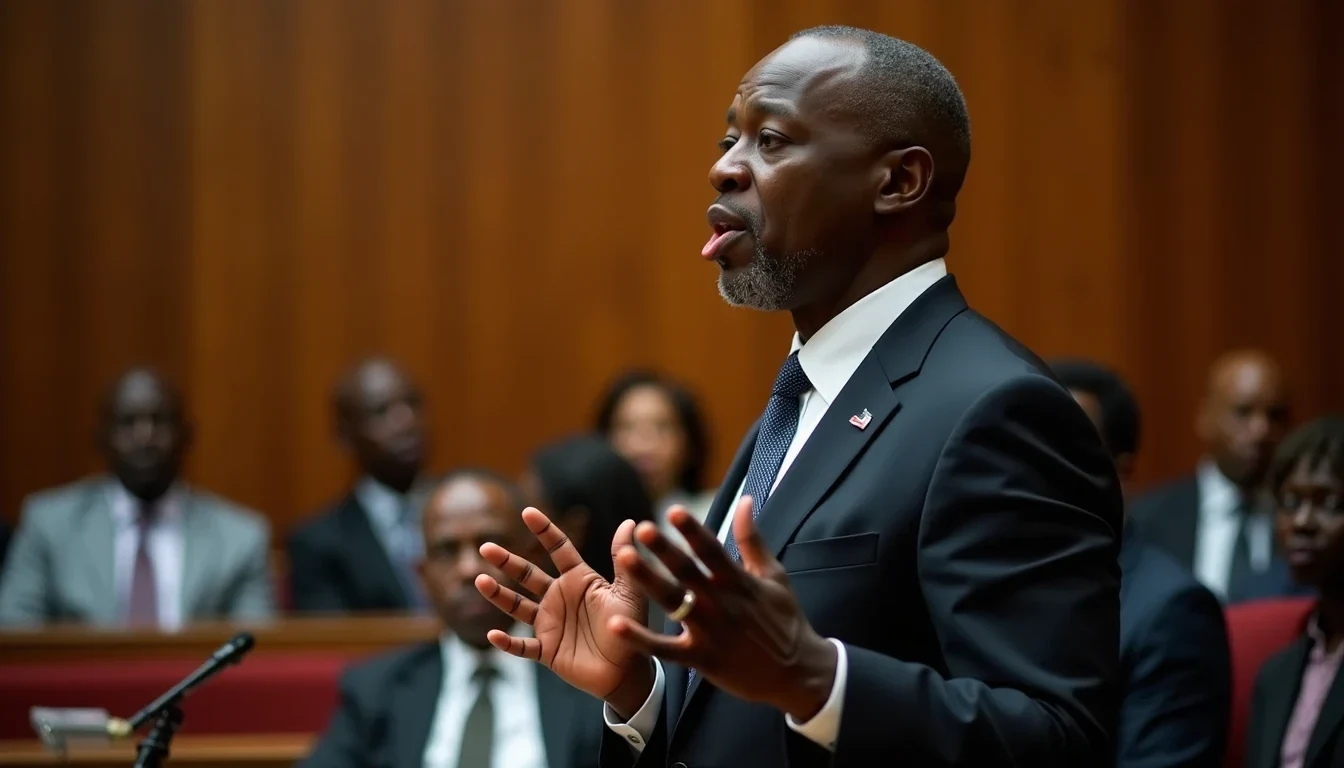
A particular humiliation is built into South African public life: you watch someone important fumble through a prepared statement and wonder whether the bar for excellence has been permanently lowered. Then a clip surfaces of Vusumuzi Nkabinde at the Madlanga Judicial Conduct Tribunal inquiry, and the opposite happens. The man was hired to sit in the middle, to make the proceedings legible to isiZulu speakers, but he became the reason people kept watching. His hands moved with the testimony. His voice found the register of each speaker, the anger and the hesitation and the legal precision, all of it carried across in real time without a script to hide behind. On X and WhatsApp, the praise was immediate and specific: not “he is good” but “did you hear how he handled that phrase,” “did you see the confidence.”
This is worth slowing down. Court interpretation is designed to be invisible. The ideal interpreter is a window, not a painting. Nkabinde turned himself into something else entirely, and the public noticed. Many have spent their own lives code-switching between taxi rank English and boardroom isiZulu, between the language of home and the language of forms. They know how much it costs to make one world intelligible in another. Watching him, they recognised the labour.
What the job actually requires
The preparation begins long before anyone enters the courtroom. Interpreters working inquiries like Madlanga’s, where judicial conduct and legal ethics are the substance, must build a working vocabulary in two directions at once. “Prima facie” needs an isiZulu equivalent that carries the same weight. “Onus of proof” cannot become a guess. The South African Translators’ Institute and university programmes run continuous training for this, but the real work happens in private study: charge sheets, witness statements, the specific terminology of fraud versus assault versus misconduct on the bench. An interpreter who walks in cold is a liability.
The cognitive load is its own category of work. When a witness accelerates or breaks down, the interpreter cannot pause the room. They chunk speech into manageable segments, lean on trained memory techniques, and sometimes anticipate where a sentence is heading based on courtroom patterns they have internalised over years. The emotional testimony is harder still. They must sound like the witness without becoming the witness, conveying distress through prosody, pitch, pace, without absorbing it. Vicarious trauma is a documented occupational hazard. The Constitution guarantees interpretation in Section 35(3)(k), but it does not guarantee the interpreter’s sleep that night.
The craft behind the clips
Nkabinde’s performance was shareable not because of accuracy alone. Accuracy is the floor. He matched tone to speaker, found rhythmic equivalents, rendered isiZulu proverbs and idioms with equivalents that landed culturally rather than literally. When a speaker’s body language shifted, his delivery shifted with it. This is called prosodic matching, and it is the difference between translation and interpretation, between moving words and moving meaning.
Culturally specific expressions present the hardest choices. A direct rendering of an isiZulu proverb into English often arrives dead. The interpreter must know both cultures well enough to find the parallel, the phrase that carries the same warning or wisdom. Sometimes no parallel exists, and the interpreter must bridge neutrally, explaining without editorialising. Nkabinde made these decisions in real time, under camera lights, while the nation’s attention wandered elsewhere and then snapped back to him.
Why this landed now
The virality carries its own message. Nkabinde had no publicist, no brand partnership, no previous profile. His name trended because the work was undeniable. In a media environment saturated with manufactured relevance, this is almost disorienting. South African audiences encounter constant translation in daily life, between the twelve official languages, between the language of the street and the language of the state. They are sophisticated critics of interpretation whether they know the terminology or not. They know when someone is bridging worlds with fluency and when they are merely approximating.
The response also reflects how excellence gets recognised in this particular public. The main characters at Madlanga were the judges under scrutiny, the advocates, the institutional weight. Nkabinde was positioned between them by design, a conduit. That he became the focal point suggests an appetite for competence that does not announce itself, for skill that serves a function and becomes art in the serving. The group chats and timeline posts were not celebrating celebrity. They were celebrating someone who made a difficult thing look effortless, which is the oldest and most reliable reason audiences have ever had to pay attention.
The ordinary days
Most court interpreters will never trend. Their days move between criminal trials and maintenance hearings, small claims and civil disputes, interpreting for accused persons who may not fully grasp the proceedings even in their own language. The workload is heavy, resources are often thin, and emotional exposure is constant. They switch between languages multiple times before lunch. They sit with testimony no one should have to hear twice, their own neutrality a professional requirement that does not protect them from the content.
Nkabinde’s moment was exceptional, but the conditions that produced it are not. The skill was there because the job demands it, every day, without guarantee of notice. What the public saw in those clips was not a performance prepared for an audience. It was the standard, finally visible.