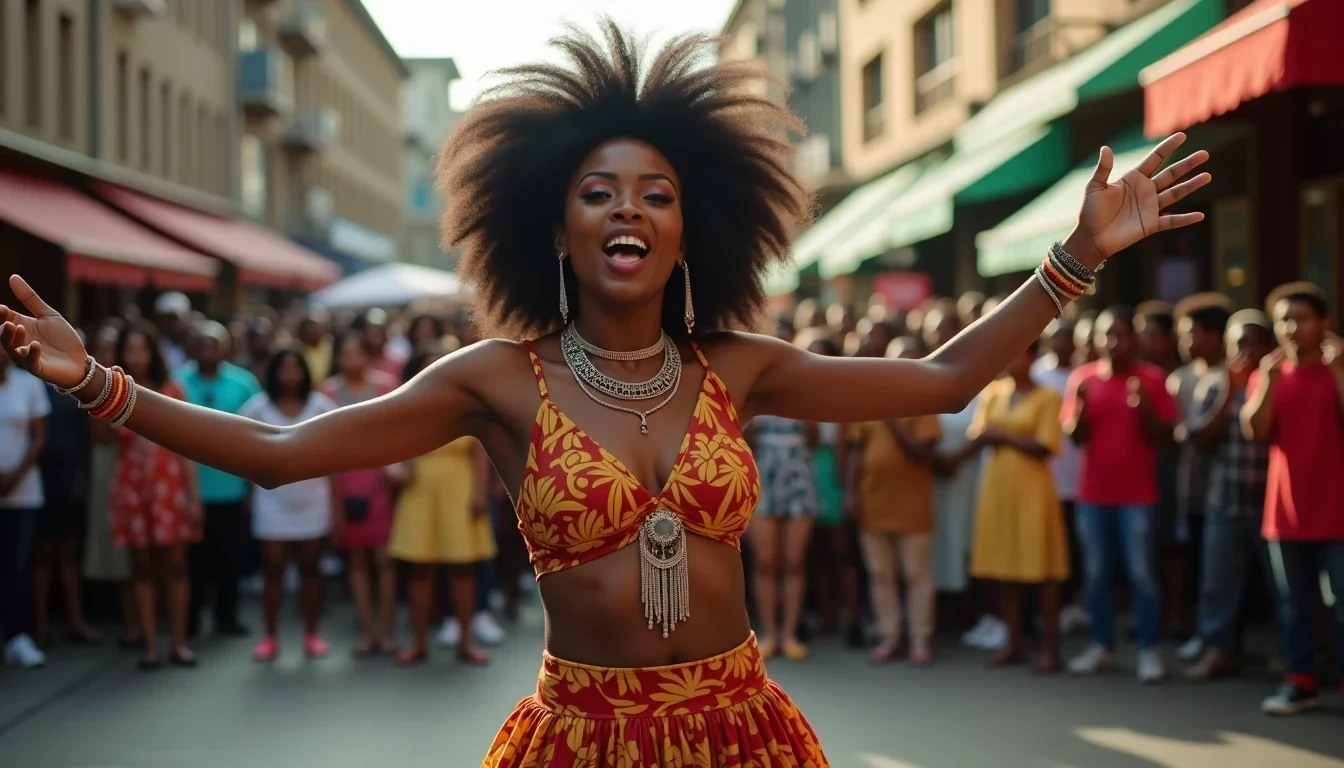
The first time Tyla told an American radio host she was “coloured,” the internet reacted predictably. Clips circulated. Comment sections filled with hot takes from people who had never stepped foot in Bonteheuwel, let alone understood how the word functions in a South African mouth. The host’s face registered surprise. Tyla kept talking, not pausing to footnote her own existence.
That moment defines her second album, A\Pop*. The Johannesburg-born performer has built a global career on a sound she named herself: “popiano,” a deliberate grafting of pop melody onto amapiano’s log-drum heartbeat. She dances the pouncing cat on international stages. She drops isiZulu and isiXhosa into verses without subtitles. She wears South African designers to events where every other artist arrived in houses from Milan or Los Angeles. She has done all of this while refusing the quiet pressure to become more legible to the people watching.
What “coloured” means when you say it from Cape Flats soil versus a Brooklyn podcast studio
The American understanding of the word runs through Jim Crow and civil rights marches and a specific violence that makes the term unspeakable in polite conversation. South Africa’s usage carries its own weight, but it is different. Here, “coloured” names a multiracial community with a specific history, a specific culture, a specific place in the taxonomy that apartheid constructed and that post-apartheid South Africa has neither fully dismantled nor fully reformed. Tyla was not using a slur; she was stating a fact about herself that any South African would hear as ordinary.
The confusion that followed said less about her and more about the assumption that American racial grammar should function as universal default. She was asked to explain. She did, briefly, and moved on. The episode became a reference point in every subsequent profile, the moment where global audiences realised that Tyla would not be performing translation services for free.
Why international interviews keep asking her to define herself
Watch enough foreign press rounds and a pattern emerges. The questions arrive with polite bafflement. What is amapiano? Where does it come from? What does “yebo” mean? Can you show us the dance? The framing treats South African culture as a puzzle that Tyla has been tasked with solving for strangers. She answers because that is the game of promotion, but she does not simplify or sand down the edges.
Local coverage reads differently. South African outlets have tracked her rise with the particular pride of people who recognise the taxi rank in the background of a music video, who catch the slang without needing a glossary, who see a Sandton mall aesthetic rendered in high definition for the world. The debate at home is not whether she is authentic enough, but whether any artist should have to carry this load of explanation at all.
Should the world meet artists halfway
There is a commercial argument for translation: make the references clearer, drop the slang, explain the history, and build a bigger tent. Tyla’s counter-argument is playing out in real time. A\Pop* arrives with its amapiano drums intact, its Johannesburg texture unsmoothed, and it is finding its audience anyway. The success of “Water” already proved the point: a song built on South African dance moves and South African sonic architecture can dominate global charts without asking permission.
The deeper question is about power. Who is expected to adapt, and who is expected to receive? For decades, artists from outside the Anglo-American centre have faced a choice: dilute your specificity or accept a smaller platform. Tyla is testing whether that choice is real or merely assumed. The confusion over “coloured,” the requests to define “popiano,” the occasional mislabelling of amapiano as Afrobeats by lazy international categorisation are friction points, and she treats them as features rather than bugs.
What this looks like from a group chat in Soweto
The practical effect is visible in small ways. A teenager in Tembisa sees a global star speaking the same slang they use at the spaza shop. A dancer in Durban recognises a move they grew up doing at groove, now copied in TikToks from London and Los Angeles. A conversation that used to flow one way, with South African consumers learning American references by osmosis, now runs in both directions. If you want to follow Tyla’s career with full fluency, you need to learn some things. The burden has shifted, slightly, toward the audience.
This does not mean every international listener will do the work. Some will consume the surface, the melody, the visual, and miss the context entirely. Tyla seems at peace with that. The people who want to understand will find their way to the history. The people who do not were never the core audience anyway.
A\Pop* lands as a statement of arrival, not arrival somewhere else but arrival here, fully, without apology. The world can catch up.