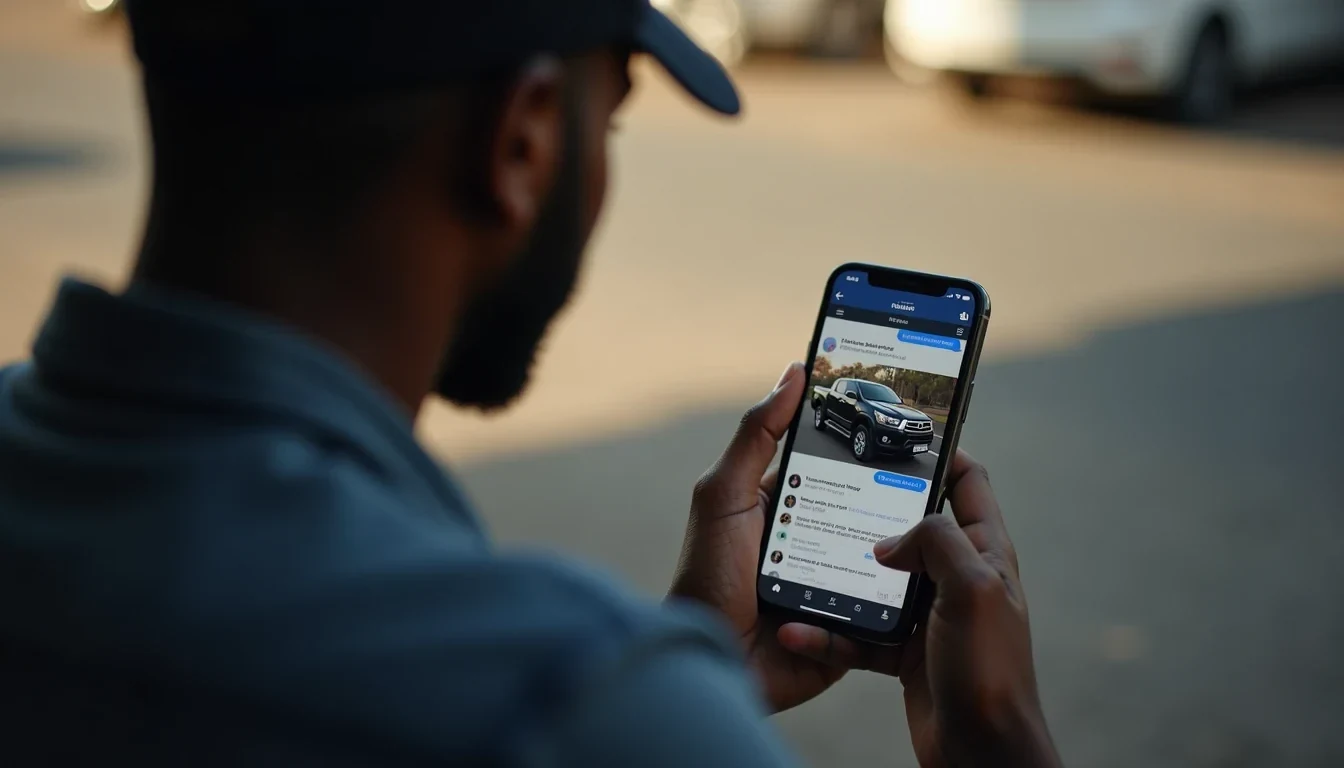
You see a 2019 Toyota Hilux on Facebook for R89,000. The post says “Bank repo, urgent sale, today only.” Your first thought is not “this is impossible.” Your first thought is “who do I know who works at the bank?”
Scammers exploit this exact gap. They know you have seen real repo sales before, or heard of someone who got a deal at Burchmores. They know the price is not quite believable, but close enough that you will message them anyway, just in case. By the time you are typing “is this still available?” the trap is already half-closed.
How the con builds its walls
The advert looks almost boring in its professionalism. Stolen photographs from a legitimate dealership in Pretoria are slightly cropped so reverse image search stumbles. A Facebook page called “SA Vehicle Disposals” has 4,000 bought followers and disabled comments. The logo looks almost like Standard Bank’s, almost like Nedbank’s, close enough to feel familiar at scrolling speed.
You message. They reply within minutes, warm and efficient, already calling you “my brother” or “sister.” They move you to WhatsApp immediately, away from public view. There they send documents: an “auction certificate” with a convincing stamp, a “bank release form” with a signature that looks official because it is copied from a real document posted online last year. The vehicle has a VIN. The VIN belongs to a Hilux in Cape Town that was never repossessed, but you do not know that yet.
Then comes the pressure. “Five other buyers are asking.” “The bank needs clearance by 4pm.” “If you deposit the R15,000 holding fee now, I can hold it.” The fee goes to an account held by “J. Molefe,” not a company name. When you hesitate, they soften: “Tell you what, just R8,000 to show serious interest.” Every concession feels like proof they are real people negotiating. This is choreography; they have done this fifty times this month.
What legitimate sales actually look like
Real repossessed vehicles do not move through WhatsApp chats with strangers. A bank that has gone through the legal process of repossession, a process that itself involves court orders and months of paperwork, does not then hand the car to a random person with a Facebook page to sell at 40% of market value.
The major banks (Absa, FNB, Nedbank, WesBank, MFC) partner with established auction houses like Burchmores, Aucor, Park Village Auctions, or MFC’s own auction division. These sales are public events, advertised in advance with dates, locations, and catalogues. You register to bid, often paying a refundable deposit of R5,000 to R10,000 that sits in a trust account. You view the vehicle physically, usually on a designated day before the auction. You bid in a room with other people, or through a verified online platform tied to the auction house’s systems. You pay the auction house’s trust account, not a personal account. There is no “today only.” The process is slow by design because the bank needs an auditable sale to satisfy its own compliance requirements.
A spokesperson for one major auction house, who has watched these scams proliferate, put it plainly: “We never ask for money before a viewing. We never sell through social media adverts that bypass our official channels. The moment someone pushes for a deposit to ‘secure’ a vehicle you have not seen, you are not talking to us.”
The psychology of the almost-bargain
The scam works because it does not ask you to believe something ridiculous. It asks you to believe you are slightly smarter than everyone else, slightly faster, slightly more connected. The “today only” phrase is not just urgency; it is a filter. It selects for people who are already half-convinced that rules do not fully apply to them, that they have found a side door.
This is why the victims are not only the obviously gullible. They are people who know the market, who have been priced out of it, who have watched car prices climb while wages stagnate. The R89,000 Hilux is not believable to someone who is not paying attention. It is precisely believable enough to someone who desperately wants it to be true, who has already done the mental work of justifying why this one time, the exception might be real.
Scammers understand this better than most marketers. They anchor you to an impossibly low price, then ask for a “small” deposit that still feels like a bargain compared to the full market rate. They use fake authority, bank logos and official-sounding names, because authority bypasses critical thinking. They get you to commit incrementally: a message here, a document there, a deposit to maintain consistency with your own growing investment of hope.
How to check before you pay
The verification steps are simple and almost never followed. Take the company’s registration number and check it on the CIPC website. Does the company exist? Do the directors match the names you are given? Call the bank or auction house whose branding is being used, using a number you find independently on their official website, not the one the seller provides. Ask if this vehicle is in their system. Ask if this seller is an authorised agent.
Demand to view the vehicle at a verifiable business address. Not a “storage facility” in a township you cannot locate. Not a “remote warehouse” that requires payment first. A real auction house has real premises, and they want you to come, because physical attendance drives competitive bidding.
Check the VIN through TransUnion or another vehicle history service. Is the car actually registered? Does the ownership history match the story you are being told? Is there still outstanding finance, which would make a clean sale impossible?
Finally, check the account. A legitimate auction house takes payment into a business or trust account, held in the company’s registered name. “J. Molefe” is not a trust account. It is a person, and that person is the only one who will see your money again.
The Hilux for R89,000 will be gone by morning, the post deleted, the WhatsApp number changed. Someone else will be “my brother” by afternoon. The only part that stays constant is the deposit, moving one way, never back.